Magnus on his dream trip – sailing across the Atlantic
The dream of sailing across the Atlantic and proudly wearing red trousers has followed Magnus Jeppsson for a long time. When the family celebrated Christmas in Gran Canaria in 2018, and he stood in the harbour watching boat after boat disappear towards the horizon, he knew it was time to make the dream a reality – even if it meant doing it without his wife Kerstin.
“I, like many other sailing enthusiasts, have long dreamt about sailing across the Atlantic and being able to wear red trousers with pride.”
Name: Magnus Jeppsson | Sailing trip: Atlantic 2019
No one else in my family has ever been drawn to this type of long-distance sailing. My wife Kerstin prefers day trips, dinner and a good night’s sleep in a quiet harbour, which I also think is a great sailing lifestyle. But the dream of long-distance sailing has always been there in the back of my mind. However, I realised early on that if it was going to happen, it would have to be with people other than my nearest and dearest. For Christmas 2018, the whole family including adult children were in Gran Canaria and had a great week in the sun. During that week I did several rounds of the harbours on the island and looked enviously at the boats that were about to embark on a big adventure. Imagine getting to spend several weeks on the wide open sea.
The dream grew and became a reality
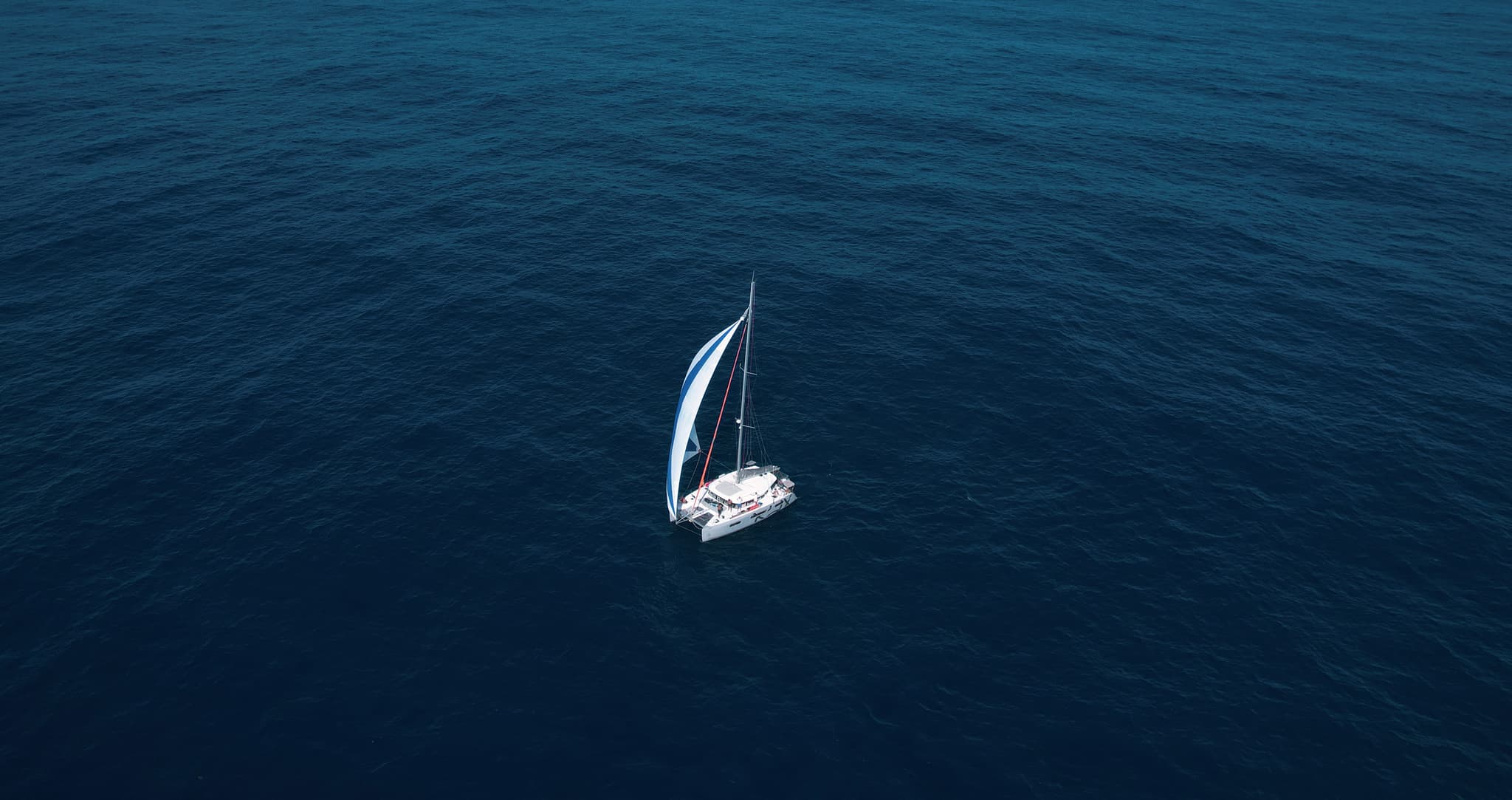
The desire to make the dream a reality grew and when I returned home I started looking around the internet for possible options. I soon found More Sailing in Gothenburg, who arrange charter sailing both in the Mediterranean and the Caribbean. More Sailing also usually take part in the annual ARC (Atlantic Rally for Cruisers) race between Gran Canaria and St. Lucia in the Caribbean. On these sailing trips you can join as “paying crew”. This year they entered the competition with two Lagoon 52 catamarans. I was initially sceptical about sailing a catamaran but soon got used to the idea. After some discussion with More Sailing, I finally signed up for ARC starting in November 2019. Now it was finally happening!
Preparing for the big adventure
To start preparations for this adventure, we had a meeting with the entire future crew during the spring of 2019 in Gothenburg. We were going to be 10 people on board, including a skipper and a first mate from More Sailing. The remaining eight were paying crew, just like me. It was very exciting to meet the whole crew who were going to spend a month together on board. None of us knew each other from before, so it was a bit of a social experiment how we would thrive and function as a group. As everyone knows, it's not so easy to get away and have your own time on a yacht. However, everyone turned out to be very nice and positive. Our team building started straight away during this first meeting.
A busy week in Gran Canaria
In the middle of November, it was time to start the adventure in earnest. According to our plans, we would first have a week together in Gran Canaria before the start of the race. The boat was already there in Las Palmas when we arrived. It was brand new from the shipyard in France and had been transported down the week before. Our first week was full of activities. First of all, we would stock up the boat with all the supplies you need for about three weeks at sea. There were many trips to various shops and a lot of deliveries of goods to the jetty. Since there was a freezer on board, we also prepared a lot of staple foods that were then frozen. We also bought a lot of fruit and vegetables that were stowed on board and hung up in nets. It was important to wash everything thoroughly to ensure that there were no stowaways on board in the form of cockroaches and other insects. It is not simple to plan meals for ten people on a trip like this.
During the week in Las Palmas, the ARC organisation also offered various activities. There were many different interesting talks to go to. There were experienced long-distance sailors, meteorologists and other specialists who gave talks on everything from safety, weather, astronomy and food planning. The crews also had the chance to socialise together. It was very international in the harbour, with about 190 boats starting from many different countries.
There are quite high safety requirements for the boats to compete in ARC. This applies to both personal and boat equipment that must be in place. In the days before the start of the race, inspectors from ARC came on board and did a thorough inspection, before giving the green light to start.
Time to cast off
After a busy week in Las Palmas, it was time to cast off and head out to sea. The starting area outside the harbour was full of boats, and those of us who were a bit unaccustomed to handling a larger catamaran had to quickly learn some sailing exercises and how to manoeuvre this somewhat unwieldy craft. It is really a different sensation to steer this type of larger double-hulled boat when you are used to monohull boats. However, we got off to a good start and soon sailed ahead into the sunshine on a broad reach with the gennaker hoisted, at a speed of 10-12 knots in the brisk wind. We now had about 2700 nautical miles to go before reaching the finish line in the Caribbean.
Even though there were almost 200 boats at the start, the competition soon spread out and after a day there weren’t many competitors left in sight. We quickly got into our onboard routines of keeping watch, cooking and having time off. We had set up a rolling watch schedule that included three hours on shift and then five hours of free time. This meant that you never got to sleep more than five hours straight, so it was necessary to also use parts of your free time during the day to sleep, so that you could get enough rest. However, it was very easy to get into this routine and our bodies adapted to a split sleep schedule.
Life aboard a catamaran
Sailing a catamaran is something special because the boat doesn’t heel. In rough seas, there will of course be a lot of motion, with the boat pitching up and down. However, the catamaran doesn’t tilt, which means that stowage of all items on board is not quite as critical and you can move around a little easier on board without having to hold on all the time. I had expected that at least some of the crew would suffer from seasickness in the first few days. However, there were only a few people who had mild problems during the second day at sea. After that, everyone felt fine the whole trip.
Accommodation on board was quite comfortable, with two people per cabin. There was also a fresh-water shower available that you could treat yourself to roughly every other day. We had a watermaker on board that converted seawater into fresh water. All the water used for cooking and washing came from this appliance. However, we had stockpiled about 350 litres of bottled water for drinking. It is easy to forget to drink enough in the heat. You had to pay attention to the slightest sign of a headache, which is a symptom of dehydration.
After about four days at sea on a southwesterly course towards Cape Verde, we had reached latitudes where the trade winds prevail. They blow from the northeast and east. We then turned westwards, setting a course towards the southern Caribbean. When you sail at these latitudes on a westerly course, you more or less always have a broad reach or run, with varying wind strength. You might think that sounds quite comfortable, but it can also be frustrating when the wind dies down and the sails flap and bang in a weak downwind. There can also be stronger winds sometimes, so you should always be careful not to be hit by an accidental gybe. That’s why you always have some type of preventer to avoid injury. Another wind phenomenon that occurs from time to time are squalls. These are local vertical cumulonimbus clouds that form above the relatively warm sea’s surface. They are quite similar to the thunder clouds that we have at home, but without the noise. However, they can bring heavy rain and strong winds that arrive suddenly. You should therefore keep an eye out for them so that you’re prepared to reduce sail if needed.
“The simple life on a boat”
After a week at sea, I started to really get into the wonderful feeling of the simple life on a boat. This is when life mostly revolves around being on watch, water, wind, eating and sleeping. I really appreciate being completely disconnected from email, text messages, TV etc. A wonderful sense of camaraderie also developed on board, with many intimate and deep conversations during the night watches under a fantastic star-filled sky.
After 10 days, we passed the theoretical midpoint of the trip, which means there are 1350 nautical miles left to St. Lucia. Those are distances worthy of respect. Being out here and coping alone also deserves respect. If something serious should happen on board, you are far away from land. In the best case scenario you can get help from another boat that is in the vicinity. Therefore, it is important to be careful and avoid injury. On board we’ve managed to avoid any major injuries. It’s mostly been hand injuries from handling the halyards and sheets. Sailing gloves can be a pretty good idea sometimes...
Unexpected visitors
We also had a lot of wonderful wildlife experiences during the sailing. One day, a small finch came and landed on deck. It turned out to be a little goldfinch. It seemed to be quite tired after a long flight at sea. We put out water and a small bowl of seeds on the deck, which the finch immediately started pecking at. This little bird stayed with us on board for several days. He flew around the boat a bit when we were swapping the sails and doing other things on the deck, but he always came back. After a week, however, he disappeared. We wished him good luck and hoped he would find another boat to rest on, because we’re very far from land.
Often flying fish skimmed above the surface of the water around us. These small fish perceived the boats as something dangerous and used their flying abilities to escape. However, there were times when they landed on the boat accidentally. In the mornings, you had to do a round of the deck to remove the flying fish that had ended up there during the night. On one of the days, the hatch to one of our cabins happened to be ajar. A flying fish managed to fly straight into the bunk of one of the sleeping crew members. He had a rude awakening and sheets that smelled faintly of fish throughout the rest of the journey.
For most of the sailing we had fishing lines trailing behind the boat. We got bites quite often, which gave us a welcome addition to our provisions. The fish we caught the most was mahi-mahi. This is a great fish for eating and delicious meals were prepared with it. We also hooked a tuna once. Fortunately, it was only about 10-12 kg and we hauled it up after half an hour of struggling. Tuna fish can be much bigger than that and we probably wouldn't have been able to deal with a larger one with the fishing gear we had on board.
At some point we also saw large pods of dolphins playing and jumping around the boat. You can never get enough of watching these amazing animals that move so smoothly in the water. When they arrived, they were usually in groups of 20-30 that stayed around the boat for a quarter of an hour or more. It made you want to jump in with them. It was quite a comfortable temperature for swimming – 29 degrees in the water.
Land in sight
On the afternoon of the 18th day, we set our sights on land! It was St. Lucia and also the island of Martinique which is right next to it. We crossed the finishing line in the early evening and glided into Rodney Bay Harbour on St. Lucia. On the jetty when we docked, there was a welcoming committee with representatives from ARC. They welcomed us and invited us to a rum punch, which is a local drink that’s very popular in the Caribbean. During the days we spent in Rodney Bay, it was lovely to be reunited with the crew members from the other competing boats. There was a lot of partying and making new acquaintances over rum punch.
Even though the sailing had gone fantastically well with a great atmosphere on board, it was still nice to be on land. It was an extraordinary experience that I will carry with me all my life. And now I can wear red trousers with pride!